Whelen vs. Federal Signal vs. Sound Off Signal: Which Emergency Lighting Brand Is Right for Your Department?
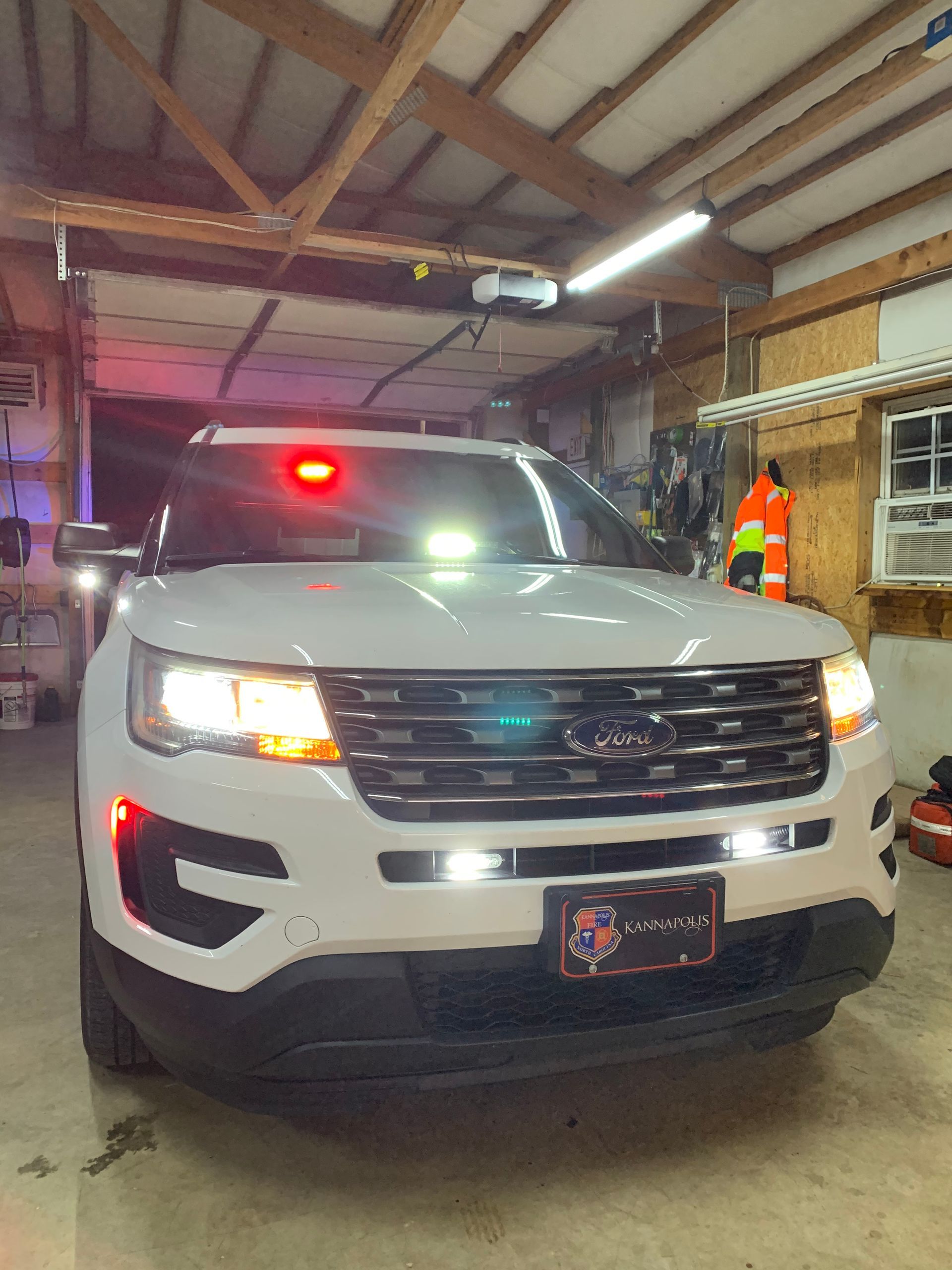
Get the brand decision wrong and you spend the next five to ten years with the wrong product line on your apparatus. A warning system that does not integrate cleanly with your siren controller creates operator override problems. A brand with limited local dealer support means the department is shipping units out of state for warranty service. And a specification driven by what the neighboring department runs — rather than by your apparatus type and documented operational requirements — is a specification that cannot be defended in a liability context.
CVMS is an authorized dealer and installer for Whelen Engineering, Federal Signal, and Sound Off Signal. We install all three in North Carolina regularly, which means we have specific, unsponsored opinions about where each leads and where each falls short. Here is the honest comparison.
Brand Positioning: What Each Company Actually Does Best
Whelen Engineering
Whelen Engineering has manufactured emergency lighting equipment in Chester, Connecticut since 1952. It is the dominant brand on fire apparatus in North Carolina and across the Southeast, with a product line that covers every component of a warning system — lightbars, intersection lights, scene lighting, siren controllers, traffic preemption — under one roof. The Liberty, Edge, and Cencom product lines are the most commonly specified on fire apparatus from the major truck manufacturers.
Whelen's core competitive advantage is system depth. The Whelen Network protocol allows a single Cencom controller to manage all warning functions with reduced wiring complexity and clean operator interface. If you want one manufacturer for the entire warning system on a fire apparatus, Whelen is the specification that defends itself most easily.
Federal Signal
Federal Signal Corporation is the dominant brand in law enforcement and government EMS fleet applications. The Integrity and Legend lightbar series and the SS2000/Screamer siren line have been standard-issue on North Carolina law enforcement vehicles for decades. Federal Signal's product development tracks law enforcement operational requirements: intersection warning, traffic advisor patterns, and dash-grille configurations designed for high-cycle patrol car environments.
Federal Signal's engineering advantage is in law enforcement duty cycles. A patrol car running 24 hours a day in a triple-car county sheriff fleet has different wear demands than a fire apparatus that runs 500 calls per year. Federal Signal builds to those demands.
Sound Off Signal
Sound Off Signal occupies a specific and defensible position in the market: the highest raw photometric output per mounting footprint in the grille and intersection lighting category. Their nFORCE series produces candela numbers that Whelen's equivalent grille products do not match in head-to-head testing. Where Sound Off Signal falls short is in product breadth — they do not manufacture a complete warning system, and their siren controller line is limited.
Sound Off Signal is not a primary warning system brand for most North Carolina fire apparatus. It is the brand you add to a Whelen or Federal Signal primary system when daylight-condition intersection visibility is the specific documented failure mode you are trying to address.
CVMS installs all three brands and will specify the right product for your apparatus — not the highest-margin option. Call (704) 267-7259 for a specification consultation. Written quotes available for NC department procurement.
Direct Comparison
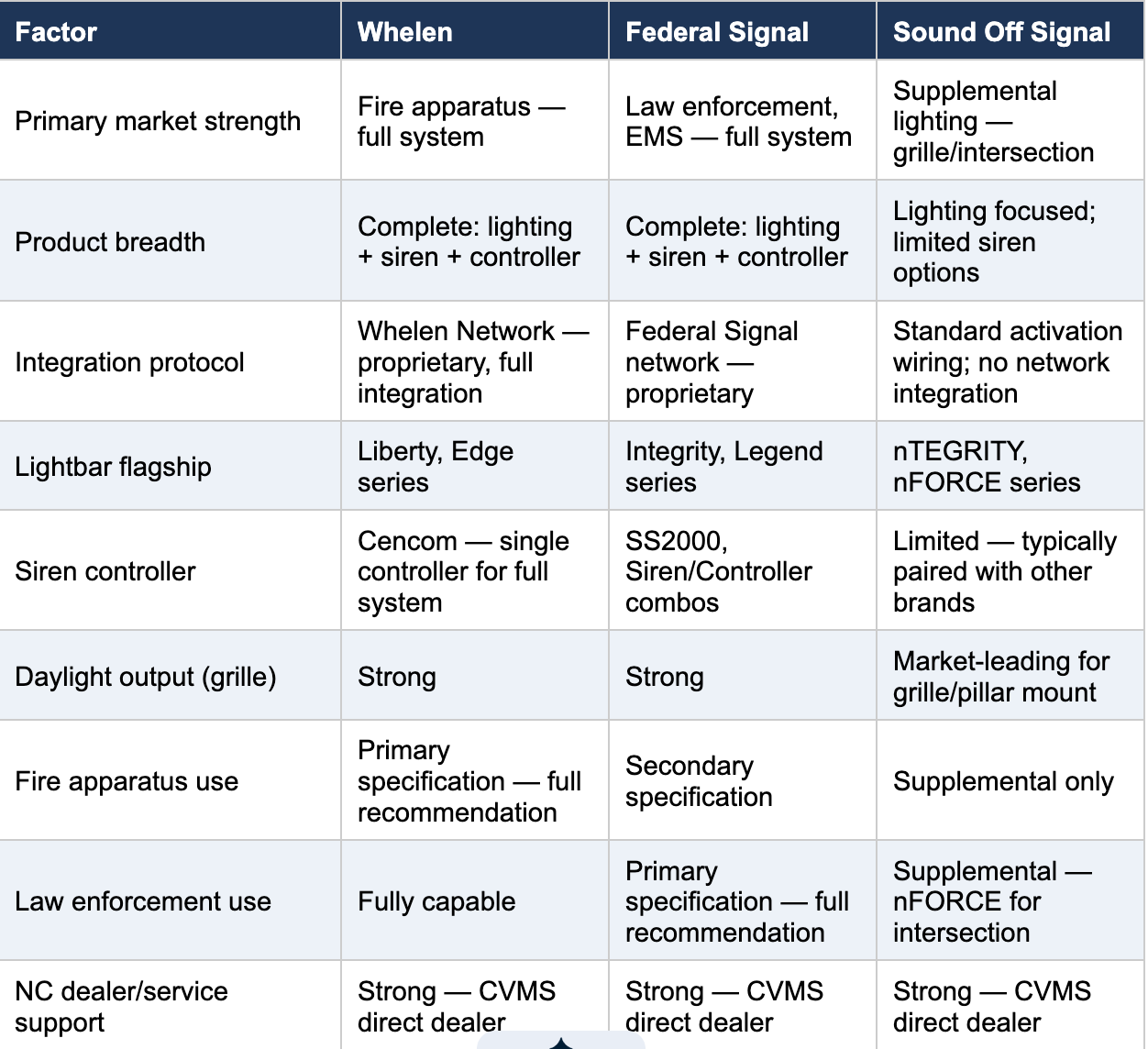
When to Specify Each Brand
Specify Whelen When:
- You are upfitting fire apparatus and want a fully integrated warning system from a single manufacturer
- Your department has an existing Whelen fleet and controller standardization matters for operator training and interoperability
- The apparatus requires scene lighting, traffic preemption, or specialty warning components — Whelen's product depth covers these without third-party integration
- Long-term parts availability and NC dealer support are priorities — Whelen's distribution in the Southeast is the strongest of the three
Specify Federal Signal When:
- You are upfitting law enforcement or EMS vehicles where Federal Signal's product line matches agency or state standards
- Your fleet already runs Federal Signal siren controllers and operator familiarity is a priority for personnel across multiple vehicles
- High duty-cycle patrol car applications — Federal Signal's engineering for continuous law enforcement use is the differentiator here
- Traffic advisor pattern requirements are the primary specification driver — Federal Signal's TA series has the strongest NC law enforcement specification history
Specify Sound Off Signal When:
- Intersection warning effectiveness is the documented failure mode you are addressing — nFORCE products lead the market on photometric output in this category
- You are supplementing an existing Whelen or Federal Signal primary system with additional grille or pillar lighting
- Daylight-condition law enforcement visibility is the specific problem and you have the budget to address it with the highest-output available product
Mixed-Brand Specifications: When It Makes Sense and When It Creates Problems
A mixed-brand specification — Whelen as the primary lightbar and siren controller on a fire apparatus, Sound Off Signal nFORCE units at the grille for intersection warning — is a legitimate approach when the specification requirement drives it. The tradeoff is integration complexity: mixed-brand systems require separate activation circuits and cannot use the single-controller simplicity of a Whelen Network installation.
CVMS wires mixed-brand installations to a clean, documented standard that avoids the activation conflicts and wiring confusion that result from non-systematic mixing. The decision to mix brands should come from specification requirements — not from leftover inventory from a prior project.
The CVMS Specification Recommendation for NC Departments
For North Carolina fire departments starting a new apparatus upfit: Whelen. Product depth for fire, local dealer support, NC market dominance, and the cleanest single-manufacturer integration available. If your department already runs Whelen, the case for staying on that platform is even clearer.
For NC law enforcement fleet managers: Federal Signal as the primary system on patrol vehicles, with Sound Off Signal nFORCE units as supplemental intersection lighting where daylight visibility has been documented as a safety concern. This combination is installed across multiple NC agencies and performs well.
The honest caveat: the right specification depends on your specific apparatus, existing fleet, operational requirements, and budget. CVMS provides specification consultation before any product is ordered. The goal is the system that serves your department correctly — not the most expensive option.
Frequently Asked Questions
Is Whelen better than Federal Signal for fire departments?
For fire apparatus specifically, Whelen holds the stronger product position for NC departments — broader fire-specific product line, stronger regional dealer network, and more complete integration capability. Federal Signal's strength is in law enforcement and EMS. Neither brand is universally superior — the correct answer depends on apparatus type and application.
Are Sound Off Signal lights brighter than Whelen?
In the grille and intersection light category, Sound Off Signal's nFORCE products produce among the highest candela output per mounting footprint in the market. Head-to-head photometric testing shows nFORCE leading Whelen's equivalent grille products in daylight-condition output. Whelen's full lightbar systems have different specifications relevant to overhead warning. The brightness comparison is most meaningful within the same product category and mounting application.
Can CVMS mix brands on the same apparatus?
Yes. CVMS installs mixed-brand systems and wires them to a documented, clean standard. The decision to mix should be driven by specification requirements. CVMS will advise on where mixing is straightforward and where it creates integration complexity the specification does not require.
Do I need a specific brand to meet NFPA or NC DOT compliance?
No. NFPA and NC DOT standards specify performance requirements — light output, coverage, mounting height — not brand requirements. A correctly specified and properly installed system from any of the three brands meets applicable standards. Non-compliance typically results from incorrect product selection or improper installation, not from brand choice.
Authorized Whelen, Federal Signal, and Sound Off Signal dealer — CVMS provides specification consultation before anything is ordered. Call (704) 267-7259 or visit cvmsnc.com/vehicle. Written quotes for NC procurement processes available on request.