Outboard Motor Repair vs. Replacement: How to Make the Right Call for Your Boat

The repair estimate arrives and it's more than you paid for the boat. Or the estimate is manageable, but this is the third repair in two seasons on the same motor. At some point, the question stops being "what is this repair going to cost?" and starts being "is this engine worth repairing?"
This is a math problem. But most boat owners are solving it with the wrong numbers — comparing the repair cost to the replacement cost rather than comparing the repair cost to what the engine is actually worth. Here is the complete decision framework, including the costs that do not appear on the repair estimate.
The Numbers Most Boat Owners Are Not Counting
The repair estimate shows you one number. It does not show you:
- The cost of the next repair: a repair to one system on a high-hours engine does not address deterioration in every other system. The thermostat is replaced. The impeller, the cooling passages, the injectors, and the seals are at the same wear level they were before the repair.
- Fuel costs across the remaining engine life: older carbureted and first-generation EFI outboards use measurably more fuel at cruise RPM than current-generation engines. At 100 hours per year on a 150 HP engine, a 10 percent fuel efficiency difference is approximately $200 to $350 annually in real fuel cost depending on current gas prices and your typical speed.
- The cost of unreliability: a motor that stranded you once has established a pattern. The value of completing a full day of fishing, reaching the offshore mark, or getting home before a storm is not quantifiable — but it is real.
- Reduced resale value: a boat with a repaired, high-hours outboard sells for less than a boat with a new Suzuki. Installed value of a repower at resale is typically 60 to 70 percent of engine cost — not dollar-for-dollar, but meaningful when you're comparing total ownership costs.
If you're running the numbers on repair vs. replacement, call CVMS at (704) 267-7259 — we'll give you a straight assessment: what the repower costs, what financing looks like, and whether the repair alternative actually makes sense for your engine. Visit cvmsnc.com/suzuki-repower.
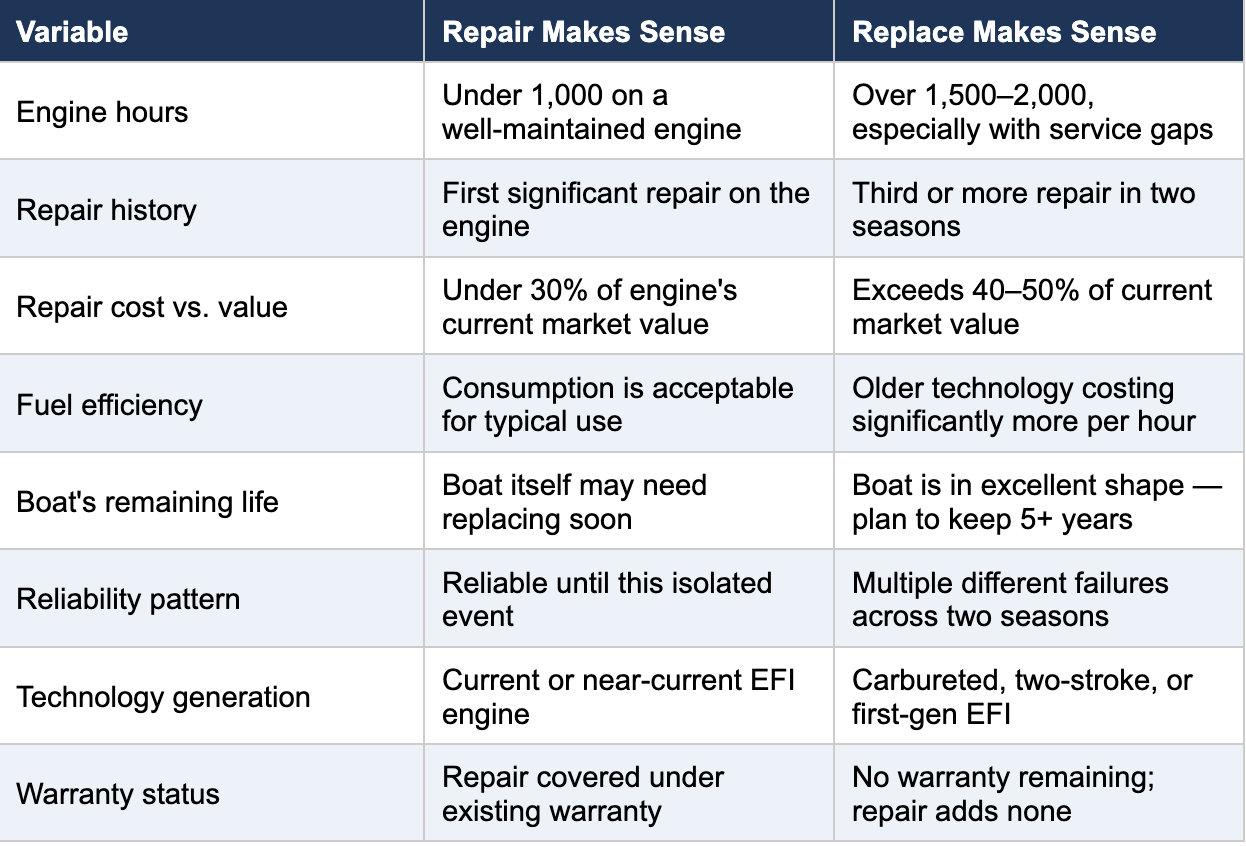
The Decision Framework
When Repair Is the Right Answer
An engine under 1,000 hours that has been properly maintained and has experienced an isolated failure — a water pump impeller, a thermostat, a sensor — is a mechanically sound engine with significant remaining life. Repairing it is the correct decision. You are addressing a specific failure on an asset that is not at the end of its life.
The same applies to engines still under manufacturer warranty. A warranty-covered repair has no meaningful cost argument for replacement. Complete the repair, preserve the coverage, and run the engine to its natural decision point.
When Replacement Is the Right Answer
The Repair Exceeds Half the Engine's Value
If the engine is worth $3,000 on the current used market and the repair estimate is $1,800 — you are not repairing an asset. You are spending $1,800 to defer the replacement decision by some number of seasons on an engine whose remaining value is $1,200. The math does not favor the repair.
The Engine Has a Pattern of Different Failures
Three different repairs in two seasons — not the same thing three times, but three different systems failing — is an engine communicating its remaining trajectory. The third repair does not stop the fourth. A high-hours engine with a pattern of different failures is failing across systems.
The Technology Gap Is Significant
A 2007 carbureted two-stroke on a bass boat you plan to fish hard for the next decade is not just an aging engine — it is a compounding disadvantage. Every season you use it, the gap between its performance and a current Suzuki four-stroke — in fuel economy, clean cold starts, digital integration capability, and noise — is the same. That gap is available to close at any time for the cost of a repower. It does not close on its own.
The ROI Calculation with Real Numbers
Here is the calculation that most boat owners do not actually run. Take a specific scenario: a 2009 carbureted 150 HP outboard on a bass boat used 100 hours per season, with two repair events averaging $650 each over the last two seasons, and fuel consumption running 15 percent higher than a current Suzuki DF150A at typical cruise RPM.
Annual repair spend: $650. Annual fuel cost differential at 100 hours (assuming 3 gallons/hour at 15% disadvantage, fuel at $3.75/gallon): approximately $169. Total annual cost of keeping the engine beyond purchase price: $819/year. Over five years: $4,095 in repair and fuel cost premium — with no warranty and a motor that still has uncertain remaining reliability.
A Suzuki DF150A repower at CVMS — installed, rigged, warranted — is priced in the mid-$15,000 range depending on rigging configuration. Financed over 60 months at a competitive rate, the monthly payment is approximately $280. That is $3,360 per year. Against the $819 annual cost of keeping the old engine, the payment is higher. But the payment comes with a three-year Suzuki factory warranty, known fuel consumption, zero surprise repair risk for the warranty period, and a boat that is worth more when you decide to sell it.
The calculation changes in favor of replacement even faster when the old engine has a third repair event, when fuel prices rise, or when the old engine strands you and adds a tow and a day off the water to the ledger.
Run your specific numbers. If the math is close, the warranty and reliability arguments close the gap in most cases.
Frequently Asked Questions
At what engine hours should I consider a repower?
Hours are a rough proxy — maintenance history and operating conditions affect actual condition far more than hours alone. A well-maintained 2,000-hour freshwater engine may have significant remaining life. A neglected 800-hour saltwater engine may already be a repower candidate. The decision is based on actual condition and repair history. When in doubt, call CVMS for an honest assessment: (704) 267-7259.
How much does a Suzuki repower typically cost at CVMS?
Repower cost depends on horsepower, rigging requirements, and hull type. CVMS provides a complete written quote at the estimate stage. Submit the form at cvmsnc.com/suzuki-repower for a quote on your specific engine and hull.
Can CVMS also upgrade my electronics when I do the repower?
Yes — and the repower is the optimal time for an electronics upgrade. The engine is off the boat, the rigging is accessible, and CVMS does both marine electronics and repowers in-house. Combining both in one visit is more efficient than scheduling separately and reduces the total labor compared to doing them as standalone projects.
Does CVMS offer financing on Suzuki repowers?
Yes. Financing options are available on Suzuki repower packages at CVMS. Details at cvmsnc.com/suzuki-repower or call (704) 267-7259.
Run the numbers — then call CVMS. Suzuki repower quotes, honest assessments, and financing for NC boat owners. cvmsnc.com/suzuki-repower | (704) 267-7259. Serving High Rock Lake, Lake Norman, and the full NC Piedmont.